
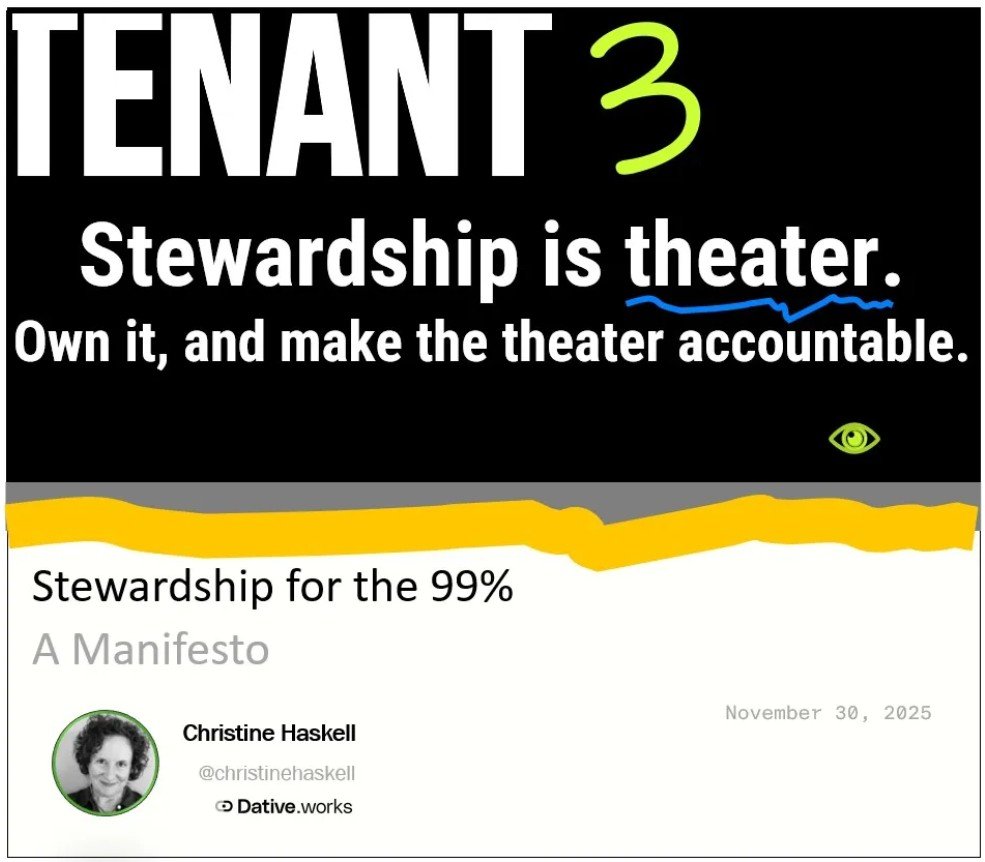
Own it, and make the theater accountable.
By now, the true innovation of our era may be in the choreography of virtue: the panel, the audit, the dashboard, the values campaign, all staged to prove responsibility without ever surrendering control. It is easy to mistake more rituals for more care. But anyone who has sat through a post-mortem town hall or glossy transparency memo knows how often these spectacles exhaust dissent instead of enabling it. What passes for transparency is frequently a technology for managing consequence, not sharing it: failure is scripted into apologies and metrics while the machinery of extraction not only survives, but earns fresh legitimacy.
The task of stewardship is not to denounce theater itself, but to seize the script. If every institution is a stage, then audits, dashboards, pledges, and “listening sessions” must be written so that those most affected can interrupt, revise, or halt the show. That means mechanisms where an apology can trigger concrete veto rights, where an ethics review can stop launch, and where the people being measured can demand receipts, not just reassurances. Performance without proof is PR; performance with shared jurisdiction becomes a tool of common governance.
This is not hypothetical. In 2018, when Google workers learned their code was being used for Project Maven, management answered with tightly scripted listening sessions and ethics language that left the underlying deal intact. Instead of accepting the ritual, more than 4,000 employees signed a public letter and coordinated walkouts, forcing the company to back away from the project and making workers, not the comms team, the real veto point. The Algorithmic Justice League has taken a similar approach to facial recognition: using participatory, community-rooted audits and public pressure to push major vendors to suspend or rework their products, proving that accountability has teeth only when those being scanned and scored can co-author the terms.
Across sectors, emergent practices show what contestable accountability looks like in the wild. Participatory data reviews give communities structured ways to examine and challenge how their data are used, rather than leaving judgment to a closed circle of experts. Cities experimenting with algorithmic appeals allow people to contest automated risk scores and demand explanations, turning “oversight” from a static report into a live, reversible process. Where journalists, workers, advocates, and affected communities share evidence, language, and timing, the old accountability rituals start to answer downward and outward, not just upward to boards and shareholders.
Stewardship does not mean abolishing performance; it means refusing one-way stages. Dashboards, audits, model cards, and values campaigns will continue to exist, but the measure of their legitimacy is whether those they name can stop them, rewrite them, or use them as leverage. If responsibility remains something performed at you, rather than with you, then autonomy has been reduced to a brand word and consent to set dressing. If, instead, the lights come up and the audience can walk onto the stage, armed with receipts, appeal rights, and shared decision power, then theater becomes a site of democratic repair.
Sidebar: Making Accountability Contestable
Here are emerging protocols that make performance truly answerable:
Participatory Data Audits: Veto rights for those impacted; Data for Black Lives’ “Community Review” sets a new standard.
Platform Appeals: New York and Amsterdam grant data subjects the right to contest algorithmic risk scores, setting legal and ethical precedents.
Solidarity Coalitions: Resource ledgers and open appeals—journalists, workers, and data rights orgs co-author accountability scripts for powerful platforms.
When workers, subjects, and journalists align, rituals become real democracy; jurisdiction and veto are no longer theater, but shared governance. When cross-disciplinary coalitions act, rituals like audits and panels become answerable; jurisdiction is exercised from below, not just above. The public sees how ethical performance can be interrupted, and how jurisdiction and veto are co-authored across sectors. Collective organizing makes the stage genuinely open for revision.
Why does this matter?
Because these examples provide the path forward, they illustrate a diagnosis, visible tools, and examples of how movements make accountability real.
Every institution, whether financial, political, or economic, is a kind of stage. We’ve lived with dashboards for transparency, big speeches, and meticulously branded value promises, often substituting optics and metrics for the accountable, material change real people need. As many political campaigns and leadership dynasties have shown, the machinery of performance risks absorbing real demands, rerouting dissent into the glamour of process.
But stewardship is not about shaming the mere existence of theater. It’s about breaking the audience/actor divide. We insist: every act on this stage (e.g., every dashboard, pledge, and “values” campaign) must be written to answer those affected, not just those watching. Performance without receipts is PR. Make responsibility contestable, reversal possible, and jurisdiction public.
We must remember
The technology of accountability can become a technology of ritual if its scripts aren’t co-authored and its outcomes aren’t reversible by those it claims to protect. For example, cameras, audits, and metrics alone don’t bring justice; they require the active, ongoing participation of those most affected to ensure results are genuine, not mere performance.
Accountability tools like audits, panels, and dashboards often serve double duty: they appear to enable transparency and governance while at times insulating managers and platforms from real challenge (Power, The Audit Society; Performance Society). As organizational scholars warn, unaccountable audits are ritual compliance, not reform. That’s the whole point. (Smith, Organizational Rituals).
Emerging governance frameworks call for “co-authored” and contestable accountability systems, where oversight rights, open appeals, and shared “script-writing” grant real jurisdiction to affected publics (see Critical Issues About A.I. Accountability Answered and Algorithmic Justice League Impact).
When organizations and systems write us out of the script, our job is not just to critique the acting, but to demand jurisdiction over the story itself. As the theater metaphor reminds us, if the curtain must rise, let it be on a stage where we can rewrite the lines and bring the house lights up—transforming ritual compliance into democratic participation.
What you can do from where you stand
If you build, launch, or manage data or AI systems
Start by asking for a real “stop” button. In every review, name who can pause or roll back a deployment, how reversals will be tracked, and how affected people can trigger them. Frame this as risk management and product quality, not rebellion.
Where you do not yet have that clarity, document the gap and propose a lightweight first step (for example, a pilot “appeals” path for one feature, or a monthly reversal review). The move is to normalize reversals as part of responsible shipping, not as a failure.
When you cannot secure any downward or outward accountability, withhold your endorsement of the ritual itself: be specific that you will speak to model limits, unknowns, and lack of appeal rights in decks, risk logs, and launch notes. This makes the performance harder to use as unearned cover.
If you teach, legislate, fund, or regulate
Treat every audit, dashboard, and model card you are shown as a draft, not a verdict. Ask who helped write it, who can challenge it, and what happens when a metric reveals harm. This keeps you in “editor” mode rather than “audience” mode.
Build practical asks into your oversight: open appeals for those who were scored, public documentation of reversals, and advisory or oversight bodies that visibly include workers, students, patients, and communities—not just executives and technical experts. Start with one pilot program or funding condition rather than trying to redesign the whole institution at once.
Use your platform (syllabi, hearings, RFPs, policy drafts, grant calls) to normalize the language of contestability, chain of custody, and named veto points. This gives practitioners inside organizations cover to push for the same standards.
Wherever you sit
Notice when you are being asked to applaud on command—town halls, product keynotes, “responsible AI” announcements. Instead of performative enthusiasm, pause and ask simple, concrete questions: What happens if this harms someone? Who can say not yet? How often have we reversed a decision based on this system?
When you encounter accountability theater, ask to see receipts: at least one example of a decision reversed, a deployment slowed, or a metric changed because people affected objected. If no such example exists, name that absence and treat the ritual as unfinished work, not as proof of responsibility.
You do not have to be the hero or the whistleblower. Start by comparing notes with one or two others (colleagues, students, community members) and agree on one shared ask (for example, an appeal path, a more straightforward explanation, or a pause on a single high-stakes use case). Organizing begins with small, specific, shared questions.
Explore the Manifesto Series
Tenant 3: Stewardship is theater. Own it, and make theater accountable.
Tenant 4: coming soon!
New tenants are published weekly (or thereabouts) and published on LinkedIn and SubStack for updates.
Hi, I’m Christine. 👋
In a world awash in buzzwords and borrowed courage, Dative.works is a pocket of resistance—where data pros, skeptics, and stray idealists come to build something less disposable.
If you’d rather ask better questions than echo easy answers, pull up a chair. The work starts here.