
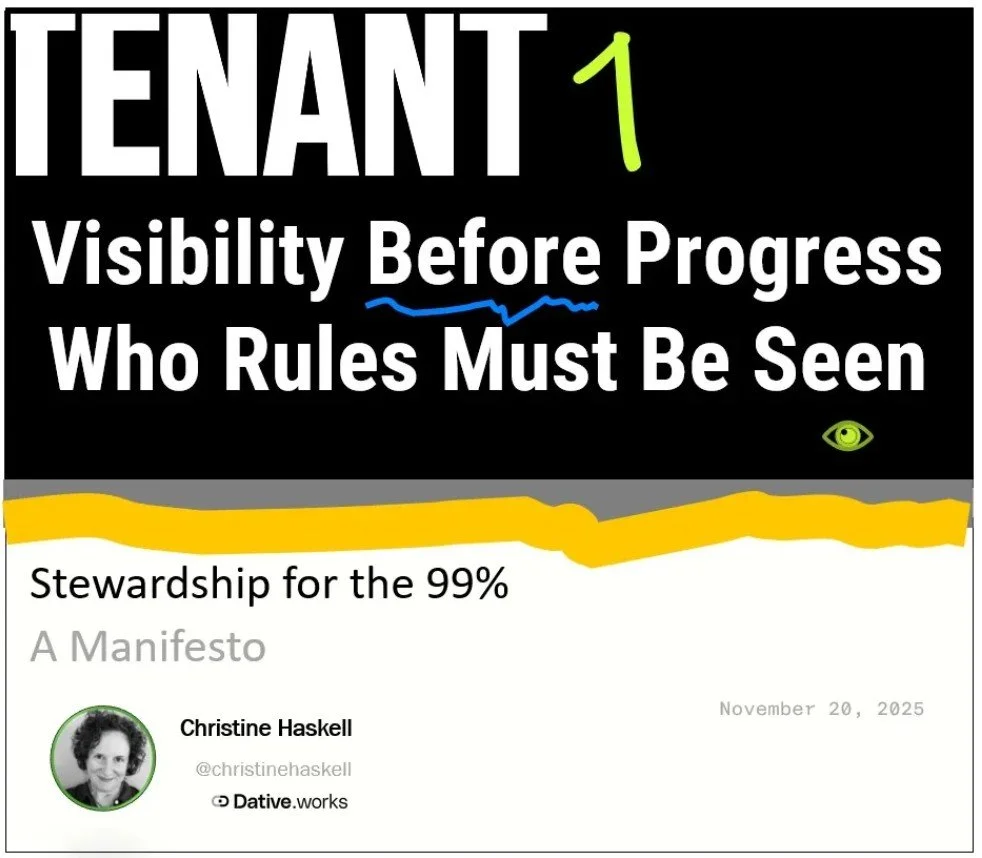
Who Rules Must Be Seen
The manifesto set the terms for what comes next: stewardship that refuses both corporate gloss and mindless hype, insisting that change begins with clarity and accountability, not just aspiration. If you missed it, the manifesto lays out what real stewards do before the world scales new systems: they demand jurisdiction, contest the defaults, and protect the right to slow things down until harms are truly visible and priced.
This tenant picks up from there. Radical visibility isn’t just our first principle; it’s the throughline connecting every steward’s task. Before we can steward AI, algorithms, or any large system, we need to see who rules, how they rule, and what that means for everyone at the table, and those left out.
Read the full manifesto here.
Every real struggle for justice begins with radical visibility. The mythology, search for meaning and good intentions, and the slogans—those come much later. Look to 1776: the Revolution ignited because a concentrated elite, a mere 2% of the population, owned two-thirds of the land and steered the rules, invisible to most and unaccountable to all but themselves. Today, the same architecture persists: a handful of directors and executives circulate through the boardrooms of the largest corporations, wielding decisive influence over the economy, government, and daily life. Their power is engineered for obscurity. Most people pay the bill, but few can even name who is setting the terms.
We cannot steward what we refuse to see.
Any talk of public interest, responsible innovation, or democratic governance is a mask if it does not make networks, incentives, and collusion behind closed doors visible. Whether it’s land, data, energy, or the very terms of employment and public discourse, the default is always concentration and opacity.
This is the Work: From Principle to Practice
Visibility is practical
Mapping networks, publishing connections, documenting decisions, demanding receipts.
Tools, laws, journalism, and activism are all needed.
It means forcing disclosures, designing systems for contestability, and ensuring public scrutiny is real and regular.
Visibility is urgent
Without it, the public lives in manufactured ignorance and democracy is performative.
Social trust is only earned where people can see influence and challenge decisions.
Visibility is not whistleblowing alone
Whistleblowers reveal hidden wrongs, but visibility must become the default, not the exception.
The risk and burden cannot fall solely on individuals inside the system, but must be shared, by design and by law.
Why this matters now
As power rewires itself in networked, digital, and global forms, radical visibility is more than exposure. It is the precondition for public agency, policy, and fairness.
Transparency must move from reactive leaks to embedded, routine visibility, so ordinary people, not just insiders, have the information, tools, and leverage to shape outcomes. For every sector, from corporate boards to AI to public offices, this means making “who rules and how” a matter of record, not rumor.
If you can’t see who rules, you are governed by them.
Justice, equity, and stewardship must always start with radical visibility. Everything else is performance to keep the engine running in the dark.
Explore the Manifesto Series
Tenant 3: Stewardship is theater. Own it, and make theater accountable.
Tenant 4: coming soon!
New tenants are published weekly (or thereabouts) and published on LinkedIn and SubStack for updates.
Hi, I’m Christine. 👋
In a world awash in buzzwords and borrowed courage, Dative.works is a pocket of resistance—where data pros, skeptics, and stray idealists come to build something less disposable.
If you’d rather ask better questions than echo easy answers, pull up a chair. The work starts here.