
CARE→ STEWARDSHIP
This work is sustained by readers.
Each month, I invest substantial time, money, and attention in keeping The Dispatch alive. It’s free to read, ad-free, and deliberately human—no sponsors shaping the message, no automation standing in for judgment.
There’s no team behind it. No interns. No assistant. It’s just me—thinking, writing, editing, and maintaining this space because I believe this kind of work matters.
If The Dispatch has helped you slow down, think more clearly, or feel a little less alone in the noise, I invite you to support it—once or on an ongoing basis. Patronage enables this work to remain independent and sustainable.
Thank you for being here.
MONTHLY DONATION
♥ $3 / month
♥ $5 / month
♥ $7 / month
♥ $10 / month
♥ $25 / month
ONE-TIME DONATION
You can also become a spontaneous supporter with a one-time donation in any amount:
Need to cancel a recurring donation? Go here.
archives
Period films taught us to notice the fine grain of class and constraint. Who opens the doors, who carries the trays, whose feelings must be swallowed so that another character’s moral awakening can unfold in peace. The AI products that now saturate daily life are built on a similarly stratified stage, where some workers appear in the credits (engineers, founders) and others remain offscreen (moderators, annotators, ghostwriters, and translators) despite being essential to the performance. In both cases, an exquisitely finished surface (an English drawing room bathed in afternoon light, a perfectly phrased chatbot reply) depends on people whose labor is designed to be forgotten as soon as the scene plays.
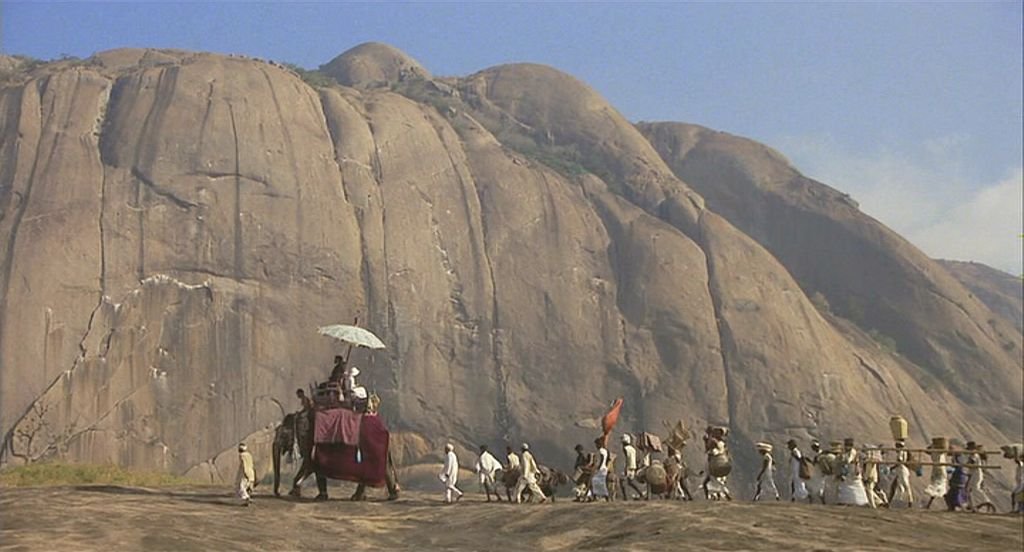
A Passage To India. Thorn EMI Screen Entertainment/HBO (1984)
Every glossy AI demo has its own backstage, just as every period drama has its own set. Generative models and “smart” platforms sit on top of a chain of human labor that most users never see: content moderators watching a firehose of violence and grief so feeds and chatbots stay nominally “safe”; data labelers rating answers, fixing transcripts, tagging crops and faces and road signs so the system can sound fluent and competent; “click‑workers” doing tiny, repetitive tasks for cents at a time, stitching together the training data that makes an AI product possible. Analysts and advocates now describe this as an “AI value chain,” warning that these workers are often poorly paid, precariously employed, and excluded from most conversations about ethics and innovation.
A recent Indian feature film, Humans in the Loop, makes that backstage world painfully specific. It follows Nehma, an Oraon Adivasi woman who returns to her village after a divorce and takes a job as a data labeler at a rural AI center, training algorithms to recognize crops and pests. She loves the forest and believes everything has its place; her knowledge comes from years of foraging and farming. When an image of a root flashes on her screen, she knows instantly (by the way the nodes sprout) that it is turmeric, not ginger. When a caterpillar appears on a leaf, she tags it as harmless because she has shown the same insect to her daughter in the forest, explaining how it eats only the decaying parts so the plant can live. The client wanted pests; her care becomes a problem. Her worldview is fed into the algorithm and treated as an error.
Outside the frame, this work is booming. Estimates suggest India’s annotation market could reach $7 billion by 2030, anchoring new data‑work hubs in small towns and rural districts and offering flexible desk jobs to women who have spent lives in fields, factories, or unpaid care. The industry is offsetting some of the jobs lost as call centers automate and voice bots replace human operators. But even as it creates opportunity, many in the field call data labeling the most undervalued part of AI, piecework that may disappear once models can label more of their own training data, leaving today’s boomtowns to face the same bust that followed the rise of call centers.
Research on generative AI and labor cautions that these systems are not replacing human work so much as redistributing and obscuring it, relying on underpaid workers to make automation appear effortless while deepening existing inequities in the global division of work. UNESCO’s ethics guidance makes the same point from the other side: if AI is to be truly equitable, societies must face the structural transformations AI entails and ensure that those at the bottom of the value chain have their rights, safety, and livelihoods protected, rather than treated as expendable inputs to someone else’s innovation story.
The rhetoric around this labor rhymes uncomfortably with the stories from Merchant Ivory sets. There, talk of “family,” home‑cooked meals, and palace picnics softened the reality of unpaid wages and impossible schedules. In tech, “assistant,” “co‑pilot,” and “empowerment” language frames AI as a benevolent helper while startups wrap overwork and underpayment in the glow of mission. “We’re not a 9–5,” “this is what it takes,” “we’re changing the world, “even as thousands of low‑paid workers train and clean up after the models that make these slogans plausible. Once you start seeing who makes a period film possible (e.g., the runners, drivers, costumers, and caterers who rarely make it into the official history), it becomes difficult not to ask a similar question of AI: who is carrying the trays here, and whose names will never appear on the poster?
Supporting the Work
This work is sustained, not sponsored.
Each month, I invest significant time, care, and personal resources to keep The Dispatch alive. It remains free to read, ad-free, algorithm-free, and intentionally human. There’s no team behind it—no staff, no interns, no assistant. It’s a one-person practice of thinking, writing, editing, and holding space.
This work is also part of my livelihood.
If The Dispatch has helped you think more clearly, slow down, notice what matters, or stay oriented in a noisy world, I invite you to support it—once, or on an ongoing basis. Patronage is what allows this work to remain independent and intact.
Thank you for being here.
Each month, I invest substantial time, money, and attention in keeping The Dispatch alive. It’s free to read, ad-free, and deliberately human—no sponsors shaping the message, no automation standing in for judgment. There’s no team behind it. No interns. No assistant. It’s just me—thinking, writing, editing, and maintaining this space because I believe this kind of work matters. Your contributions enable this work to continue and make all the difference.
Monthly Support
Ongoing support helps keep the work steady and sustainable.
♥ $3 / month
♥ $5 / month
♥ $7 / month
♥ $10 / month
♥ $25 / month
One-Time Support
If you prefer, you can offer a one-time contribution in any amount; no commitment required.
Monthly Newsletter
If you’re looking for depth and curation, and are getting wary of algorithms determining the conversation, try the monthly newsletter. It will weave together popular posts from the past with new insights. Here is an example.
- Research
- Culture
- AI Ethics
- Technology
- Art
- Books
- Capstone Course
- Leadership
- Organizations
- Society
- History
- Architecture
- Design
- Future of Work
- Governance
- Philosophy
- Psychology
- Appalachia
- Corporate Accountability
- Craft Work
- Data
- Data Projects
- Economic Inequality
- Environmental Justice
- Illustration
- Labor and Technology
- Legislation
- Religion
- Science
- Technology & Education
- Uncategorized