
T he Governance Tricks Behind “Neutral” Harm
Summary: From this post by Abi Adamson
The awards ceremony wasn’t broadcast live. The BBC aired it with a two-hour delay, meaning this was not an unfiltered moment that simply “happened” to viewers. It was an edited broadcast. Edited broadcasts are not neutral; they reflect human judgment, priorities, and power. Both the original and the aired version had "inappropriate shoutouts.” Producers cut Akinola Davies Jr., saying “Free Palestine,” making it unmistakably clear that editorial intervention was underway. Choices were made. Among those choices, the N-word shouted at two Black actors remained. That is not neutrality. That is a decision, and decisions like that deserve scrutiny.
My question: Was it malice or incompetence?

Michael B. Jordan & Delroy Lindo, BAFTA Awards
We all know the saying: never attribute to malice what can be explained by incompetence.
In ordinary life, that’s often a useful check on paranoia. Sometimes people really do just mess up.
But institutions have learned to use that phrase like a fire blanket. The second something harmful happens, we get a familiar script: “It was complex.” “No harm was intended.” “There was context.” “People are being unfair.” Or, in this case, disability becomes the instant social hot potato. Suddenly, we’re no longer talking about what happened. whether the hurt was expressed politely enough, whether the apology sounded genuine enough.
Here’s the problem as I see it: in an edited, delayed broadcast, “incompetence” is not a personality trait. It’s a systems issue.
This wasn’t a live feed where nobody had time to react. It was a curated product. Which means there were checkpoints. Humans. Standards. Editorial judgment. Maybe no one sat in a room twirling a mustache thinking, “Excellent, let’s preserve the worst possible moment.” Fine. But that still leaves the real question: what kind of decision process produces this outcome, and why does the harm so often land in such a familiar place?
Because “not malicious” can still mean:
people didn’t recognize the harm clearly enough,
people recognized it and deprioritized it,
or people had no protocol for handling competing harms in a way that protected everyone’s dignity.
None of those are comforting.
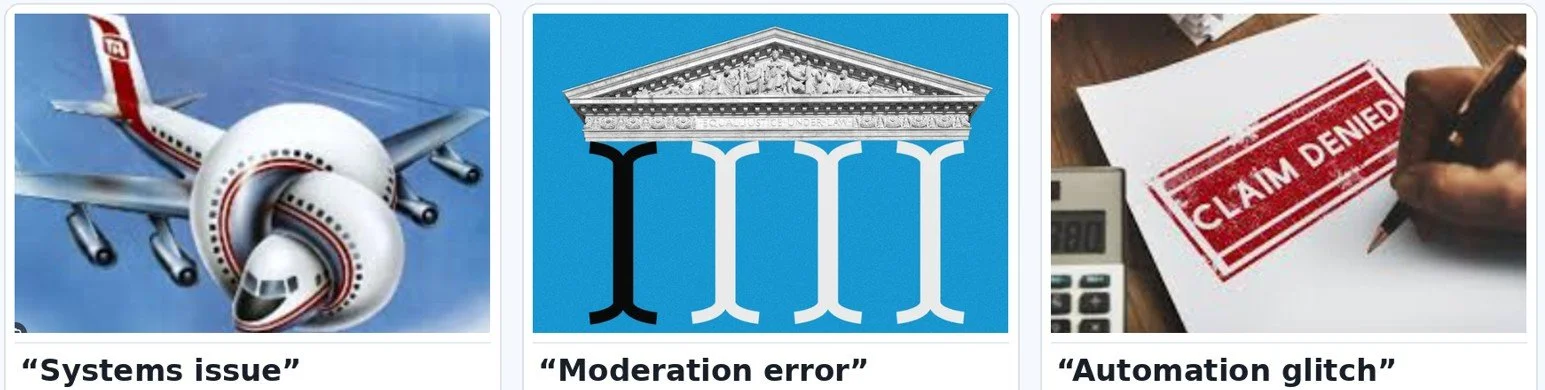
We’ve seen this pattern everywhere.
Airlines call it a “systems issue” when passengers are stranded for days, as if a software outage appeared out of thin air rather than being baked into the cost structure.
Platforms call it a “moderation error” when abuse stays up, and legitimate speech gets swept out, as if thresholds and escalation paths were set by woodland spirits.
Employers call it an “automation glitch” when pay or benefits are denied, but the burden of proof somehow falls on the person already harmed. (Funny how the “glitch” always comes with paperwork for the victim.)
That’s why the malice-versus-incompetence frame is too small for moments like this. It makes us argue about motive when we should be examining design.
This is also why the same logic shows up so often in conversations about AI. The output gets treated like weather. “The model returned this.” “The system flagged that.” As if technology has liberated us from human judgment instead of embedding it in settings, thresholds, and review processes.
AI isn’t neutral because people aren’t neutral.
Broadcast editing isn’t neutral because editors aren’t neutral.
Institutions aren’t neutral because they are made of tradeoffs.
So yes, maybe this wasn’t (explicit) malice. But the absence of malice does not end the inquiry. In public institutions, repeated “incompetence” is often just a polite word for a governance failure that some people are expected to survive gracefully.
When that neglect is predictable, repeated, and unevenly distributed, it is not neutral—it is institutional harm. That, I think, is what people are reacting to—not a lack of nuance, but a very clear recognition of the pattern.