
Meta is not merely collecting biometric data. It is turning interpersonal recognition into platform infrastructure.
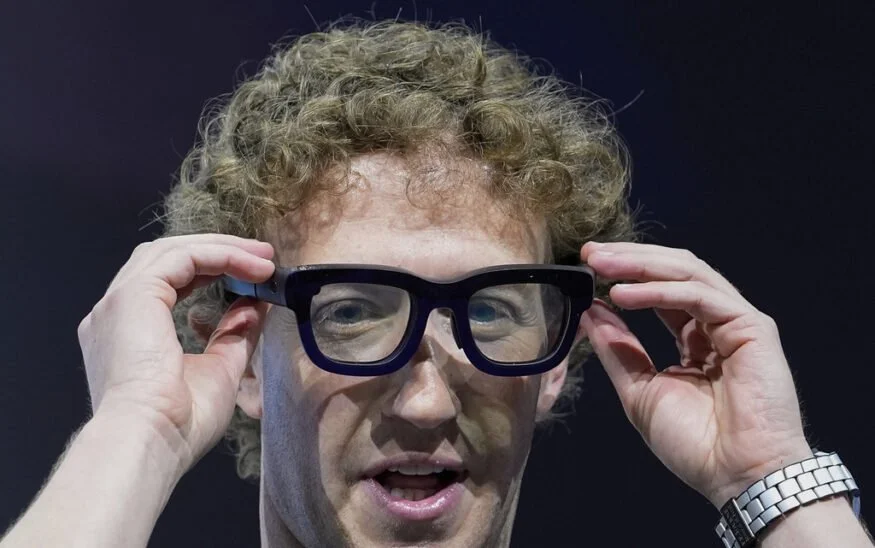
Mark Zuckerberg wears a pair of Orion AR glasses during the Meta Connect conference on Sept. 25, 2024, in Menlo Park, Calif. (AP Photo/Godofredo A. Vásquez, File) Image Credit to the respective owner.
WIRED reported that Meta had embedded an unreleased facial-recognition system, “NameTag,” in the Meta AI smart-glasses companion app, with code present since January and later removed after WIRED’s reporting. The system was designed to convert faces captured through Ray-Ban/Oakley smart glasses into biometric signatures and compare them against a locally stored database; WIRED also reported that unrecognized faces could be saved for future reference.
This matters because NameTag moves artificial mirroring out of the chatbot window and into physical space. AI systems do not simply “respond” to people. They simulate recognition, memory, intimacy, and social continuity. NameTag literalizes that concern. The glasses would allow the wearer to experience machine-mediated recognition as if it were ordinary social memory: I know you. I have seen you before. I can place you. But that recognition is no longer mutual. It is mediated by a device, structured by a platform, and potentially stored as data.
It means walking into a coffee shop and not knowing whether the person next to you is just ordering a latte or secretly adding your face to their personal recognition system.
The old privacy question was: What do companies know about me?
The new privacy question is: What can other people’s devices make me become without my knowledge?
That distinction matters because you did not download the app, agree to the terms, tap “accept,” or join Meta’s brave new opt-in beta called “Surprise, Your Face Is Now a Lookup Table.” And yet, you may still become part of the system because someone else is wearing the device.
That is the part people need to understand.
Consent collapses across relational roles. The person wearing the glasses may have installed the app; the person being scanned likely has not consented. One user’s convenience becomes another person’s involuntary data capture. The relationship is no longer dyadic. It becomes triangular, entangled: wearer, target, platform. The “target” becomes part of the system without ever entering a contract, interface, or consent flow.
What does this mean IRL?
It means surveillance is no longer only something that happens from above. It can now move through ordinary social life. Your neighbor, date, coworker, student, ex, customer, stranger on the bus, or guy in line at Trader Joe’s becomes the capture device. The platform does not need cameras on every street corner if it can put cameras on every face.
Because the glasses look like ordinary eyewear, the social cue disappears. We have norms for cameras. We have norms for phones. We know when someone raises a device and points it at us. Smart glasses collapse that signal. The person may simply appear to be looking at you.
That changes daily life in small but corrosive ways. You may begin to wonder whether you are being recognized before you introduce yourself, whether your face is being stored because someone found you interesting, suspicious, attractive, annoying, useful, or memorable, whether “public” now means available for biometric processing, and whether refusal is even possible when the interaction happened before you knew there was anything to refuse.
The system converts presence into infrastructure. A face in public space becomes a reusable biometric object. Even if the data is stored locally, the governance problem remains: recognition has been operationalized. The person’s face is no longer only socially encountered. It is rendered into a technical asset that can be compared, stored, recalled, and potentially repurposed.
That is why the risk is relational, not only informational. A standard privacy reading says biometric data was collected, or could have been collected, without consent. But the deeper harm is the reconfiguration of human encounter. Smart glasses make ordinary interaction asymmetric. One party sees a person; the other may be silently classified. That asymmetry changes the terms of social presence, especially for people already vulnerable to stalking, harassment, workplace monitoring, policing, or coercive control.
What does this mean IRL?
The problem is not that Meta built a thing that can remember faces. Humans already do that. The problem is that Meta built a thing that lets machines remember faces on behalf of people, inside a commercial ecosystem whose business model has historically been: What if your boundaries were just untapped revenue?
So the shift is not abstract. Being seen becomes being scanned. Being remembered becomes being indexed. Meeting someone may also mean entering someone else’s machine memory.
The kicker is that Meta’s removal of the code after WIRED asked questions does not make the issue go away. It makes the governance question louder: Why was this capability sitting there in the first place? Why did public accountability arrive only after independent researchers and journalists found it? And why does a company with Meta’s history around facial recognition keep returning to the same contested capability through new interfaces?
That sequence matters. Meta previously announced it would shut down Facebook’s facial-recognition system and delete facial-recognition templates, citing concerns about the technology and regulation. Texas later secured a $1.4 billion settlement with Meta over unauthorized biometric capture and use. Against that history, embedding facial-recognition code in smart-glasses infrastructure looks less like exploratory R&D and more like recursive governance failure: the same contested capability returns through a new interface, with a softer consumer story and a less visible consent boundary.
This is not just a biometric privacy problem. It is a systems problem. Meta appears to have been experimenting with converting social recognition into ambient infrastructure, in which one person’s device can transform another person’s face into a persistent technical signal.
NameTag shows what happens when artificial mirroring leaves the chatbot window and enters the street: recognition becomes wearable, consent becomes displaced, and the human face becomes platform memory. The danger is not simply that smart glasses may recognize us. The danger is that recognition itself is being redesigned as a platform service: slowly, ambiently, and often without the participation of the people being recognized.
The law may ask whether biometric data was collected without consent. I am interested in the question that comes before that: How does the system rearrange recognition, memory, and social power before consent is even possible? Who is accountable for that?
Hi, I’m Christine. 👋
In a world awash in buzzwords and borrowed courage, Dative.works is a pocket of resistance—where data pros, skeptics, and stray idealists come to build something less disposable.
If you’d rather ask better questions than echo easy answers, pull up a chair. The work starts here.