

When Recognition Becomes Infrastructure
Meta’s unreleased NameTag feature is not just a biometric privacy issue.
It points to something deeper: the conversion of interpersonal recognition into platform infrastructure.
The old privacy question was: What do companies know about me?
The new entanglement question is: What can other people’s devices make me become without my knowledge?
When smart glasses can quietly scan, remember, and classify faces in ordinary social settings, consent no longer sits neatly between a user and a company. It becomes displaced across a triangular relationship: wearer, target, platform.
That changes the meaning of public presence. It changes the meaning of being seen. And it raises a governance question that law alone cannot fully answer:
How does the system rearrange recognition, memory, and social power before consent is even possible?
My latest reflection builds from WIRED’s reporting on Meta’s unreleased facial-recognition system and connects it to the broader problem of artificial mirroring, consent collapse, and relational extraction.

The Control Room Is Not Empty
AI governance is not abstract. It shows up in the résumé that never reaches a human being, the school platform that no one can explain, the benefits form that rejects someone without a conversation, and the score that quietly narrows the options available.
My guest editorial for Leadership & Organization Development Journal is now out: “The Architecture of Accountability: Algorithmic Autonomy and the Discipline of Stewardship.”
The core argument is simple:
Leaders are not outside the systems they authorize.
When institutions fund, scale, and benefit from AI systems, complexity cannot become an alibi when harm appears.
The control room is not empty.
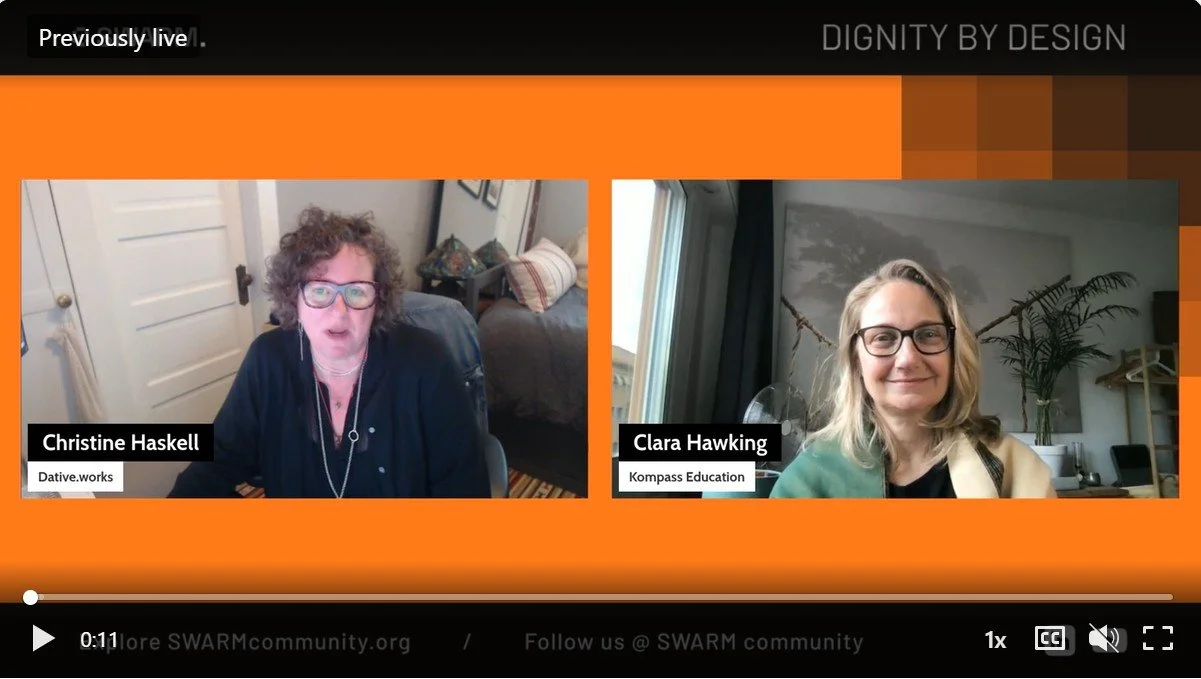
Dignity By Design: Ep. 1 with Clara Hawking
The real topic isn’t AI. It’s institutional metabolism.
Every organization has a way of converting people into throughput. Some do it politely, with performance reviews and dashboards. Others do it with cages and deportation paperwork. The forms vary; the function is remarkably consistent: the system keeps moving by offloading its friction onto someone else’s body, time, reputation, or future.
AI accelerates that metabolism. It expands the system’s ability to act at scale without direct contact, and therefore without direct accountability. When the harm comes, it arrives as a paperwork artifact: a “match,” a “risk score,” a “process.”
The reason her essay lingers with people, one participant mentioned it “haunted” her, is that modern harm is rarely theatrical. It’s administrative. It’s denial wrapped in procedure. It’s violence in the language of efficiency.