
The World Cup is about Cultural Integration, stupid.
It's never been about sports preference.
The 2026 World Cup is being marketed two ways.
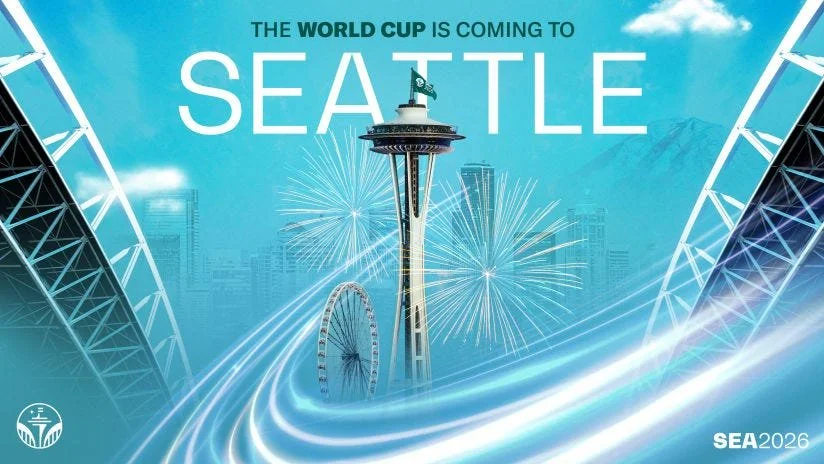
In Seattle, it arrives as civic enchantment: skyline glowing, stadium arches framing the city, the Space Needle lit like a torch. The message is aspirational: the world is coming here.
I’m supported by subscribers like you.
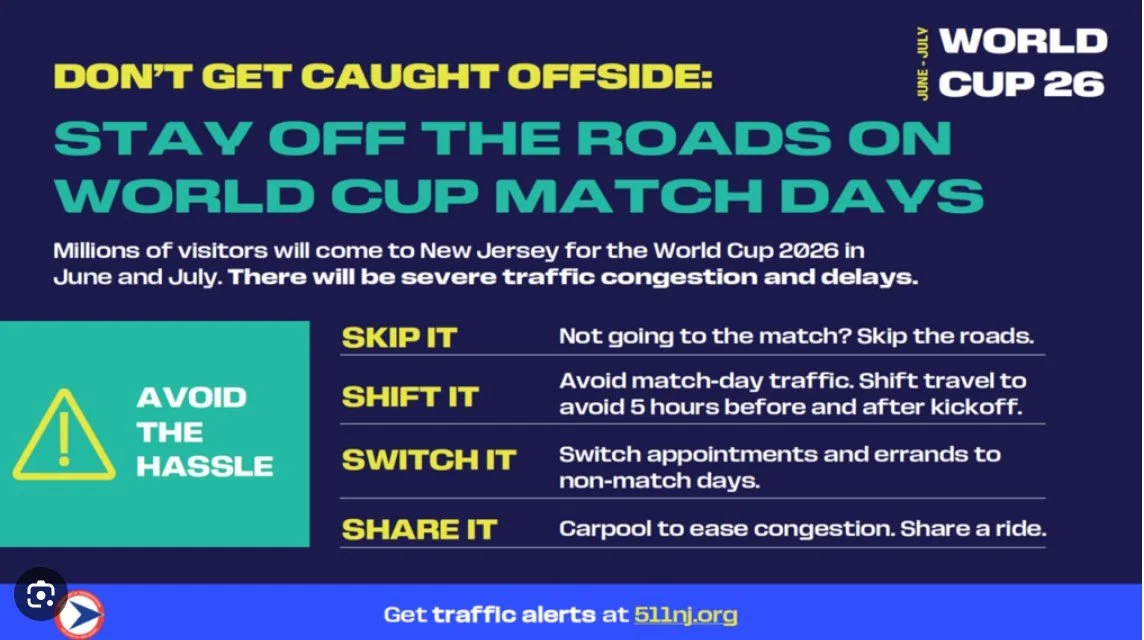
In New Jersey, it arrives as a warning label: severe congestion, avoid the hassle, stay off the roads. The message is managerial: the world will be in your way.
Both are true. Mega-events are spectacle and burden. They bring money, pride, tourists, security headaches, traffic, displacement, and an exhausting amount of branded enthusiasm. But placed side by side, these images reveal something larger than regional marketing differences.
They show a country preparing to host a global ritual without a shared cultural story about why the ritual matters.
That is what the Pew survey is really telling us. The obvious headline is that Americans lack a strong World Cup consensus. Among the 28% of U.S. adults who say they are at least somewhat likely to follow the tournament, 41% say they are unsure who will win. The top predictions are scattered: Spain at 9%, Argentina and Brazil at 8% each, France and the U.S. at 7% each.
But the buried headline is more revealing: immigrants are more than twice as likely as U.S.-born adults to follow the World Cup—54% versus 23%. Hispanic and Asian adults are also substantially more likely than White adults to say they will follow it.
This is not really a “who will win?” story. It is a story about whether the United States understands itself as part of a global public.
The survey measures cultural integration, not merely sports preferences.
The lagging indicator is this: the U.S. is hosting one of the largest global civic spectacles on earth, but the mainstream American attention system still has not metabolized its global meaning. The 2026 World Cup is the first with 48 teams and three host countries—Canada, Mexico, and the United States—and includes 104 games across 16 host cities. Yet most Americans say they are unlikely to follow it.
That is not just “soccer isn’t popular here.” It is a sign that U.S. public attention remains domestically organized even when the country is literally hosting the world.
What is not being communicated is the asymmetry between event infrastructure and cultural readiness. Cities, sponsors, hotels, broadcasters, security teams, and tourism boards are preparing for a global mega-event. But Pew’s data suggests the broader public may still experience it as background noise — unless they are already connected to immigrant, diasporic, international, or soccer-following communities.
That matters because the World Cup will expose several gaps in American soccer at once.
There is the gap between global status and global literacy. The U.S. likes being a host, market, and spectacle-maker. But many Americans do not follow the cultural grammar of the event they are hosting.
There is the gap between immigrant America and mainstream America. Immigrants are not peripheral to this story; they are the most globally attuned audience segment. The World Cup may reveal that “American culture” is less unified than advertisers and politicians pretend.
There is a gap between economic planning and civic meaning. The tournament is being framed partly as a tourism and business opportunity. But if the public story stops there, it misses the deeper question: what does it mean for a country to host the world while much of its population is indifferent to the world’s game?
And there is the gap between patriotism and prediction. Only 7% of likely followers predict a U.S. men’s win. That is not necessarily pessimism. It may simply be realism. But it also says Americans do not yet see the men’s national team as a dominant global symbol in the way they see U.S. teams in basketball, the Olympics, or women’s soccer.
The real story?
American cultural insularity is on full display at the very moment the country is being asked to perform global hospitality.
It’s not unlike our mixed reaction to Bad Bunny’s halftime show at last year’s Super Bowl. The backlash to his Super Bowl halftime show was not only about music or taste. It was about whose America gets to be legible as American on a national stage. The discomfort was not just with Spanish-language performance. It was with the reminder that American culture is already multilingual, transnational, hybrid, and not waiting for permission from the old center.
The World Cup will do something similar, but at civic scale.
It will ask the United States to extend global hospitality at a moment when American public life remains deeply ambivalent about global belonging. We want the prestige of hosting. We want the tourism. We want the economic upside. We want the skyline shot.
But do we want the cultural encounter?
Do we want the noise, the languages, the flags, the crowds, the allegiances that do not map neatly onto U.S. nationalism? Do we want to understand why this tournament is not just a sporting event, but a planetary ritual of memory, grief, rivalry, migration, class, colonial history, and joy?
The World Cup will not just test stadium readiness. It will test cultural readiness.
Right now, the signage is telling on us.
The question is not, “Why don’t Americans care about soccer?”
The better question is: What happens when the world arrives, and the host country has not fully prepared its own public to understand what is arriving?
Hi, I’m Christine. 👋
In a world awash in buzzwords and borrowed courage, Dative.works is a pocket of resistance—where data pros, skeptics, and stray idealists come to build something less disposable.
If you’d rather ask better questions than echo easy answers, pull up a chair. The work starts here.