
My first college internship: Chipcom
Building the Backbone: Why MBA and Tech Students Should Care About Chipcom
To understand why a company like Chipcom matters today, look back at the economic psyche of the early 1990s. While a brutal white-collar recession left traditional corporate America drowning in a sea of beige cubicles, mass layoffs, and bureaucratic stagnation, technology emerged as a vibrant, neon-lit escape hatch. For a generation desperate to avoid the monotonous climb of traditional corporate hierarchies, tech wasn't just a career path—it was a cultural rebellion fueled by raw meritocracy, fast-paced innovation, and the physical thrill of building the future.
Before the cloud, before SaaS, and before Big Tech ate the world, a multi-million-dollar hardware war built the modern internet. At the center of that infrastructure boom was Chipcom Corporation.
Though largely forgotten today, Chipcom is a masterclass in early systems engineering and strategic enterprise competition. Chipcom Corporation sat at the center of it all—and if anyone kept memorabilia from tradeshows from 1994, chances are, I’m the one who, according to an old resume I came across:
assisted the admin on all marketing tasks
faxed hotel reservations (yes, faxes)
made copies for every tradeshow during that year
collated binders for a 3-day event they had in Scottsdale, Arizona
[You’re welcome.]
The Ancestors of the Cloud: Chipcom pioneered fault-tolerant enterprise hubs—massive hardware switching boards that kept global corporations online. They engineered systems that could hot-swap modules without dropping network packets. The algorithmic and structural logic they used to prevent downtime in 1994 forms the physical DNA of today’s AWS and Google Cloud data centers (Tanenbaum & Wetherall, 2011).
Here is one going on eBay for $40. For perspective, modules of this caliber from Chipcom's flagship ONcore and 5000/6000 switching hubs typically retailed between $3,000 and $7,000 per module upon release. Complete, fully populated fault-tolerant chassis setups frequently climbed into the $30,000 to $50,000+ range. [That’s why it was called a bubble.]
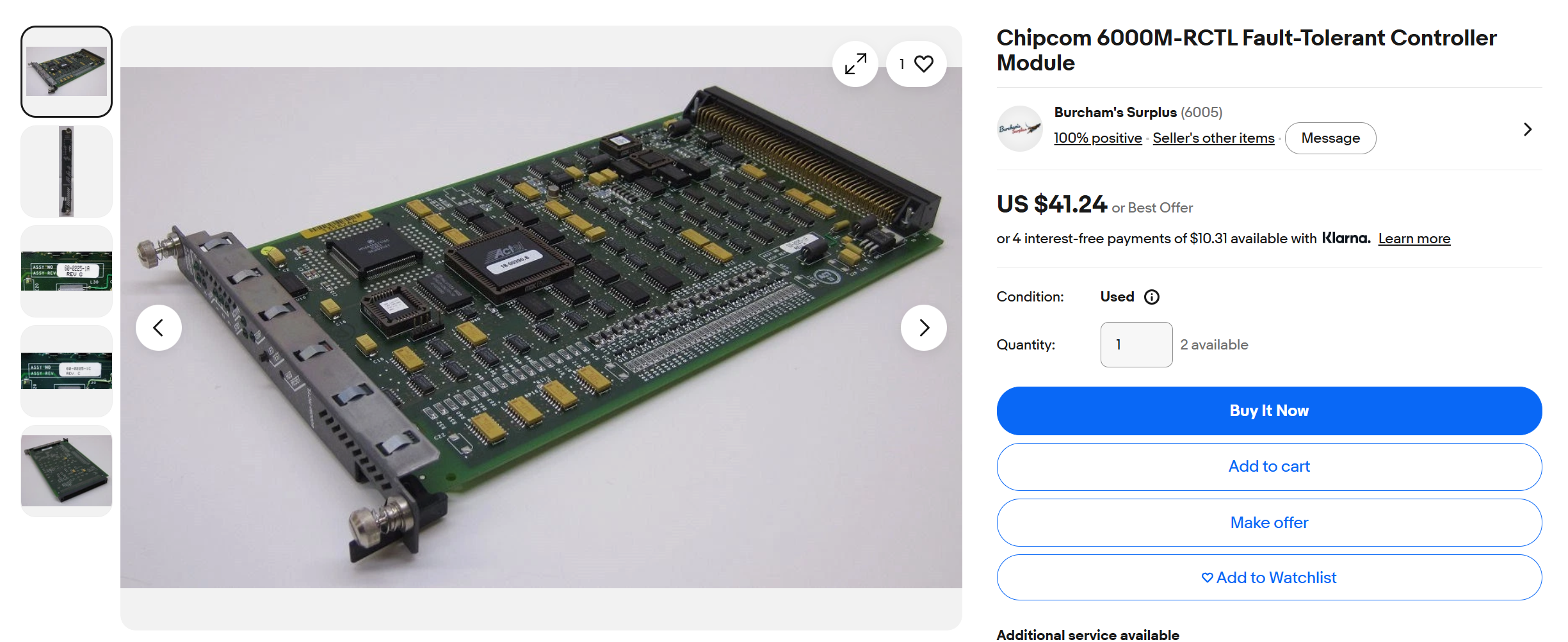
Ebay screenshot: Chipcom 6000M-RCTL Fault-Tolerant Controller Module
The Original M&A Playbook: In 1994, Chipcom pulled in $75 million in revenue as a top-tier network equipment maker. By late 1995, networking giant 3Com acquired Chipcom for $775 million in stock to defend its turf against Cisco and consolidate enterprise market share. This classic horizontal integration play mirrors modern Big Tech consolidations, illustrating how legacy heavyweights weaponize multi-million-dollar acquisitions to capture proprietary intellectual property and neutralize emerging threats (Bulkeley, 1995; Cusumano, 2004).
The Death of Hard Tech: Today’s startups launch with a laptop and cloud credits. Chipcom, however, represents the peak of the "Hard Tech" era—an era where innovation meant physically fabricating custom ASIC chips, designing heavy metal chassis, and laying proprietary cables. Their trajectory marked the exact historical tipping point when the industry realized that future profit margins would shift from manufacturing physical boxes to writing the software-defined networking (SDN) protocols running inside them.
You cannot fully understand where tech is heading tomorrow if you don't know how it was built yesterday. Chipcom's legacy reminds us that every app, platform, and digital economy we rely on sits atop physical infrastructure engineered by pioneers who solved complex, real-world problems with pure hardware.
References
Bulkeley, W. M. (1995, July 28). 3Com to buy Chipcom for $775 million. The Wall Street Journal, p. A3.
Cusumano, M. A. (2004). The Business of Software: Technologies that Work, Products that Sell. Free Press.
Tanenbaum, A. S., & Wetherall, D. J. (2011). Computer Networks (5th ed.). Pearson.