
Kindness was part of it. Ownership, refusal, and agency tell a deeper story.
Dolly Parton died on August 25, 2026, at 80. There will be thousands of lovely things written about her: the songs, the rhinestones, the wit, the movies, the generosity, the astonishing durability of a career that crossed genres, generations, regions, and political identities. All of that belongs in the record.
But I keep thinking about something less obvious. She seemed to understand that dignity is not only something you express toward people. It is something you can build into the conditions under which they live, work, choose, recover, and create.
In my work, I spend a lot of time thinking about power: who has it, how institutions disguise it, and what happens when decisions are made for people rather than with them. We often treat generosity as evidence of good character. Sometimes it is. But generosity can also leave the underlying arrangement untouched. The giver retains the authority. The recipient remains a recipient.
Look more closely at some of Parton's lesser-known decisions, though, and a different pattern emerges. Again and again, she used power to give somebody else more room to act.
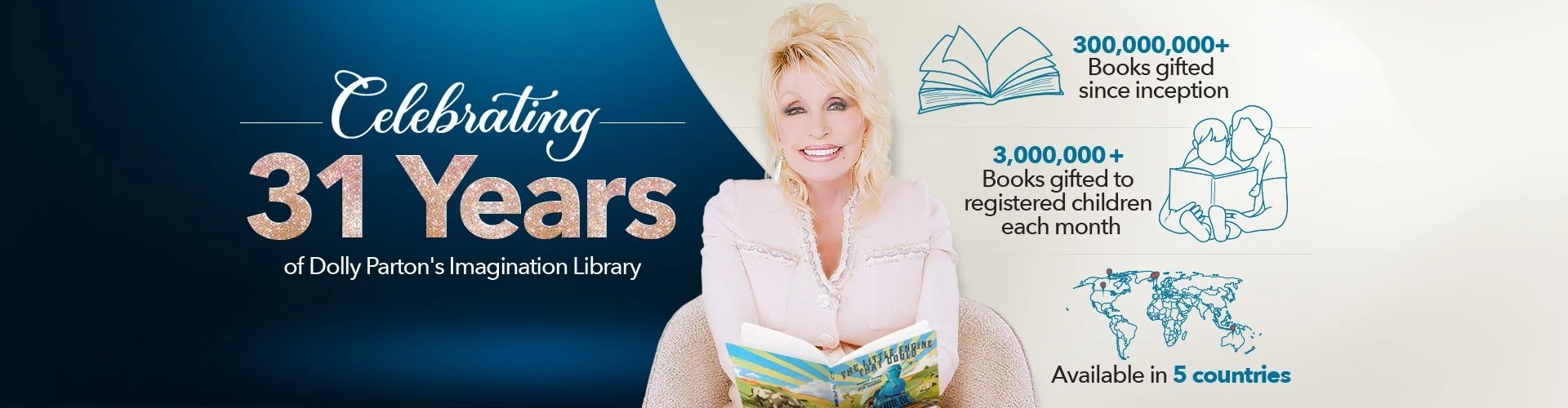
Image Source: Imagination Library
Her father could not read. So she changed the default.
The Imagination Library is now so familiar that it is easy to flatten it into a charming story: Dolly Parton loved children, so Dolly Parton gave away books.
The design is so much more interesting than that.
Parton's father, Robert Lee Parton, could not read or write. She described him as one of the smartest people she knew and believed illiteracy had limited what was possible for him. The Imagination Library began in her home county in Tennessee in 1995 as a response to that experience. Before her father died, she said, he told her it might be the most important thing she had ever done.
Notice what the program does not require.
A family does not have to demonstrate that it is sufficiently poor. A child does not have to test behind grade level. Parents do not have to document failure before help becomes available. Where the program operates, children can receive the books regardless of family income.
The books do not arrive as institutional remediation. They arrive in the mail, to the child’s home, in their name. That small design choice carries significance. The book belongs to the child. The program is deliberately structured to create the experience of receiving something meant specifically for them.
We talk endlessly about dignity in public policy, education, philanthropy, and organizational life. Then we build systems that require people to prove deficiency before they can receive assistance.
Parton built something different. She could not give her father back the possibilities literacy might have opened for him. So she changed the conditions for children who came after him.
After a disaster, she gave people money.
IMG Credit to respective owner
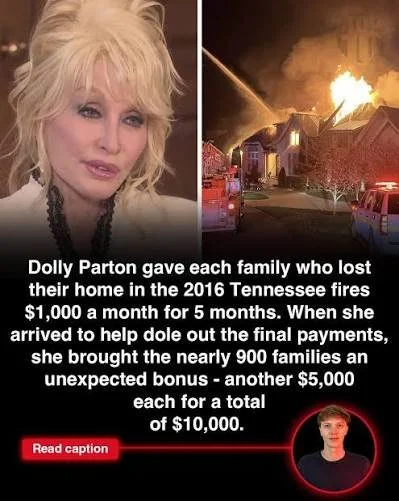
In November 2016, wildfires devastated communities around Gatlinburg and Sevier County, Tennessee. Families lost homes. Parton responded through the Dollywood Foundation by creating the My People Fund.
Here again, the design matters.
Families whose primary residences had been destroyed or made uninhabitable (including renters, not only property owners) could receive direct cash assistance. The fund initially distributed $1,000 monthly payments and ultimately increased the final payment to $5,000 as donations grew. Nearly 1,000 families participated.
The money did not come with a carefully engineered menu specifying what a displaced family was permitted to need. It was cash.
A University of Tennessee evaluation later found that recipients regained much of their pre-fire financial stability and improved their ability to save for future
emergencies. In preliminary research, cash donations were also the form of assistance recipients most frequently identified as useful.
That decision contains an important philosophy: You know what recovery requires better than I do. That does not eliminate accountability. It relocates judgment.
Compare that with the architecture of so many assistance programs. We routinely construct systems around suspicion: prove the loss, categorize the need, justify the purchase, demonstrate that you deserve the help, spend it in approved ways.
Parton's response was not without eligibility requirements, nor was private philanthropy a substitute for functioning public institutions. But once households qualified, the central intervention was remarkably direct: give people financial capacity and allow them to make decisions.
That is more than charity. It is an acknowledgment of standing.
IMG Credit: Photo Credit (L-R): Michael Ochs Archives/Getty Images, John Springer Collection/CORBIS/Corbis via Getty Images
Then there was the time she told Elvis no.
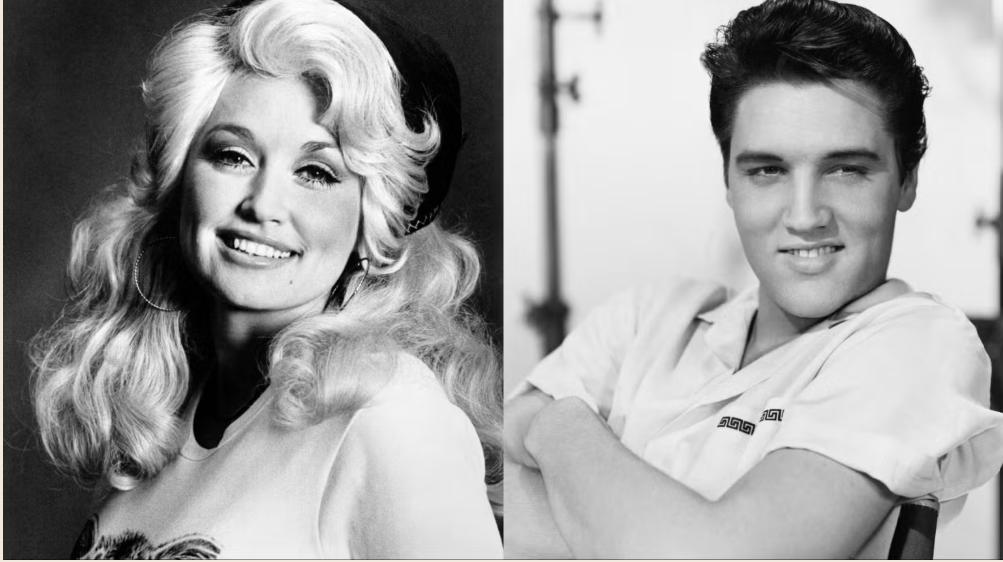
One of the most revealing stories about Parton involves something she never gave away. In the 1970s, Elvis Presley wanted to record “I Will Always Love You.” For a young songwriter from East Tennessee, having Elvis record one of her songs would have been almost unimaginable validation.
Then Colonel Tom Parker called. As Parton later recounted to Dan Rather, Parker told her that Elvis didn’t record songs unless he received at least half the publishing rights. Parton refused. She was heartbroken by the decision. But she understood what she owned.
“This is obviously gonna be one of my most important copyrights,” she recalled telling Parker. She also understood that she could eventually leave the copyright to her family. Decades later, Whitney Houston recorded the song, turning it into one of the most commercially successful recordings in popular music history.
The usual lesson drawn from this story is that Dolly Parton was a savvy businesswoman, which she was. But I think we often miss another lesson: refusal requires infrastructure.
We like to talk a lot about the “courage to say no” as though courage exists independently of material conditions. It doesn't, and it never has. People are much more capable of refusing exploitation when they own something, know its value, understand the system around it, and have enough alternatives that saying no will not destroy them.
Parton had begun building that infrastructure remarkably early. In 1967, she and her uncle Bill Owens formed their own publishing company, giving her more control over the songs she wrote. Ownership was not an afterthought once she became powerful. It was part of how she became powerful.
That shifts the Elvis story a bit (for me, at least).
Now I read it as: A young Appalachian woman was offered access to one of the most powerful men in entertainment. The price was ownership, and she decided access was not worth it. —> That is a very different kind of power story, and honestly, a much more inspiring one. She also understood that systems can be changed, which, given her circumstances, was a bold and incredibly optimistic worldview to adopt.
By RCA Records - eBayfrontback, Public Domain
Before the Imagination Library, the Dollywood Foundation tried something much smaller. In 1990, Sevier County was struggling with high school dropout rates. Parton launched what became known as the Buddy Program. Seventh- and eighth-grade students paired with another student. If they both eventually graduated, each would receive $500.
According to the Dollywood Foundation, dropout rates among the participating classes fell from 35 percent to 6 percent. Just as important, the Foundation says the initiative prompted the wider community to invest additional resources to sustain the improvement. The statistic is impressive, although we should be careful not to pretend this was a controlled social-science experiment establishing causality.
What interests me is the instinct behind the intervention. Parton did not begin by deciding that teenagers lacked character. She altered something in the environment around them. An incentive. A peer relationship. A promise extending into the future. A reason for two young people to have a stake in one another's success.
Then the community changed around them. That is a very different starting assumption from the one institutions often make when outcomes disappoint us: identify the deficient person and correct the person.
Sometimes the more useful question is: What have we designed around them?
Kindness is not quite the word. None of this requires turning Dolly Parton into a governance theorist or making a saint out of a complicated human being. She was enormously wealthy. Dollywood is a large commercial enterprise. Private philanthropy cannot repair everything public institutions fail to provide. She famously avoided many overtly political declarations, even when people on multiple sides wanted to claim her. Legitimate questions remain about what celebrity philanthropy can and cannot accomplish.
Those tensions should remain.
But “kindness” still feels insufficient to describe what was distinctive about her. Kindness describes disposition.
These were decisions.
Who retains the copyright?
Who decides what a disaster survivor needs?
Who must prove deservingness before a child receives a book?
Who gets treated as capable of choosing?
Who is allowed to say no?
Those are questions about power. Across very different parts of her life, Parton repeatedly answered them in ways that moved some measure of authority closer to the person most affected by the decision.
A songwriter kept her song.
A displaced family received money rather than instructions.
A child received a book with their own name printed on it.
A seventh grader acquired another seventh grader whose future was suddenly connected to their own.
The pattern is not perfection. It is agency. Perhaps that is one reason Parton's generosity felt different from the carefully branded benevolence we have learned to distrust. She certainly gave things away. But some of her most consequential choices were about something harder to give: room to maneuver.
There will be plenty of reasons to remember Dolly Parton; the extraordinary songwriting alone would be enough. I keep returning instead to her father. A man she believed was brilliant, living with a limitation the world had allowed to become consequential. She could not undo that history. She could not return to his childhood and put books in his hands. So she built a system that put them into millions of other children's hands instead.
Not after they failed, or t after their parents proved they were poor, but before anyone knew which child would need them most. That may be the most poignant thing about the legacy she leaves behind. She understood, perhaps without ever using this language, that agency is not merely a quality people possess.
We can design conditions that enlarge it. When we have power, one measure of what we do with it is whether the people around us leave with more of their own.
RIP.