

All Technology Projects are Data Projects
One of the biggest ideas in Driving Data Projects (the book) is that "all technology projects are data projects." Yet data is still an afterthought in many organizations—even with AI on the horizon (or now, in many firms' backyards).
Author of Data Quality: The Field Guide, Tom Redman, popularized the idea that the most important moments in a piece of data's lifetime are the moment it is created and the moment it is used. These moments often occur outside of IT. The business consumes vast amounts of data, emphasizing the importance of business involvement in data quality management. Those who have provisioned and consumed data know from experience that bad data dies hard. It will get rid of you if you don't get rid of it.

How real is Singularity? #KnowYourJargon
Singularity, the idea that technology will surpass human intelligence, is an irrelevant red herring in our current world. In becoming preoccupied with this debate, we miss numerous nearer-term milestones relating to synthetic media or misinformation being met with growing frequency and instead contemplate esoteric questions about consciousness and sentience.

Business and Technology Strategy Must Learn to Harmonize
The buzz around data and artificial intelligence (AI) often overshadows a fundamental truth: the core of any successful endeavor remains distinctly human. As businesses navigate the complexities of the digital age, the importance of human insight, empathy, and value-driven strategies becomes increasingly evident.
Transparency and Explainability Don't Equal Trust
Trust is transitioning from institutional to "distributed," shifting authority from leaders to peers, which is often overlooked and perpetuates trust issues. If trust is predictable, it isn’t needed – is it? If the inner workings of AI, government, and the media were just more transparent, if we knew how they worked, we think we wouldn’t really need to “trust” so much. It would be more predictable.

Every system is perfectly designed to get the result that it does
What if employees could enter their credentials and skills, share their problem-solving interests, and get dynamically assigned to a team based relevant to the organization’s needs? No more silos. The organization could also crowdsource expert citizen engineers with similar interests and skills for inside-outside problem-solving, where appropriate.

Taxonomy v Folksonomy
The concepts of taxonomy and folksonomy hold significant implications, especially in the context of emerging technologies like OpenAI. While traditional taxonomies offer structured hierarchies of knowledge, allowing for a systematic approach to information organization, folksonomies represent a more fluid and emergent way of categorizing information based on user-generated tags and metadata.
However, the challenge arises when technological advancements fail to incorporate divergent thinking and promote groupthink through convergent taxonomies. This phenomenon is particularly evident in language models, where developers' linguistic and cultural biases can influence the interpretation and representation of (the dominant) language.

To code or not to code? The value of Domain Knowledge in Data Teams
A little while ago, I chatted with Gartner Analyst David Pidsely about a trend I noticed in the job market. It seemed the last 2-3 years, data strategy and governance roles suddenly required coding experience.
It wasn’t my imagination, he confirmed. In 2023, skills and talent shortage were the number one inhibitor to CDAO success. Hiring managers and recruiters have been packing job descriptions with coding skills that don’t always require them.

Is it ARTIFICIAL intelligence or AUGMENTED intelligence?
Is it ARTIFICIAL intelligence or AUGMENTED intelligence?
The truth? It depends on the design's purpose. An organization’s purpose is informed by its values and profit motivation. Artificial intelligence aims to create autonomous systems that can perform tasks without human intervention, while augmented intelligence seeks to enhance human capabilities by providing AI-powered tools and assistance.

6 Myths and Misconceptions about Data Projects
As I considered how to promote my new book on driving data projects, I wanted to include myths and misconceptions that reinforce their value. I have experienced many of these in teams I’ve worked on or with. Data projects are not a static set of routines. It's a constantly evolving, open-to-innovation process.
Only 54 percent of organizations fully understand the value of project management, according to PMI's Pulse of the Profession™ report. That might explain, in part, why project success rates are so low: Less than two-thirds meet their original business intents.
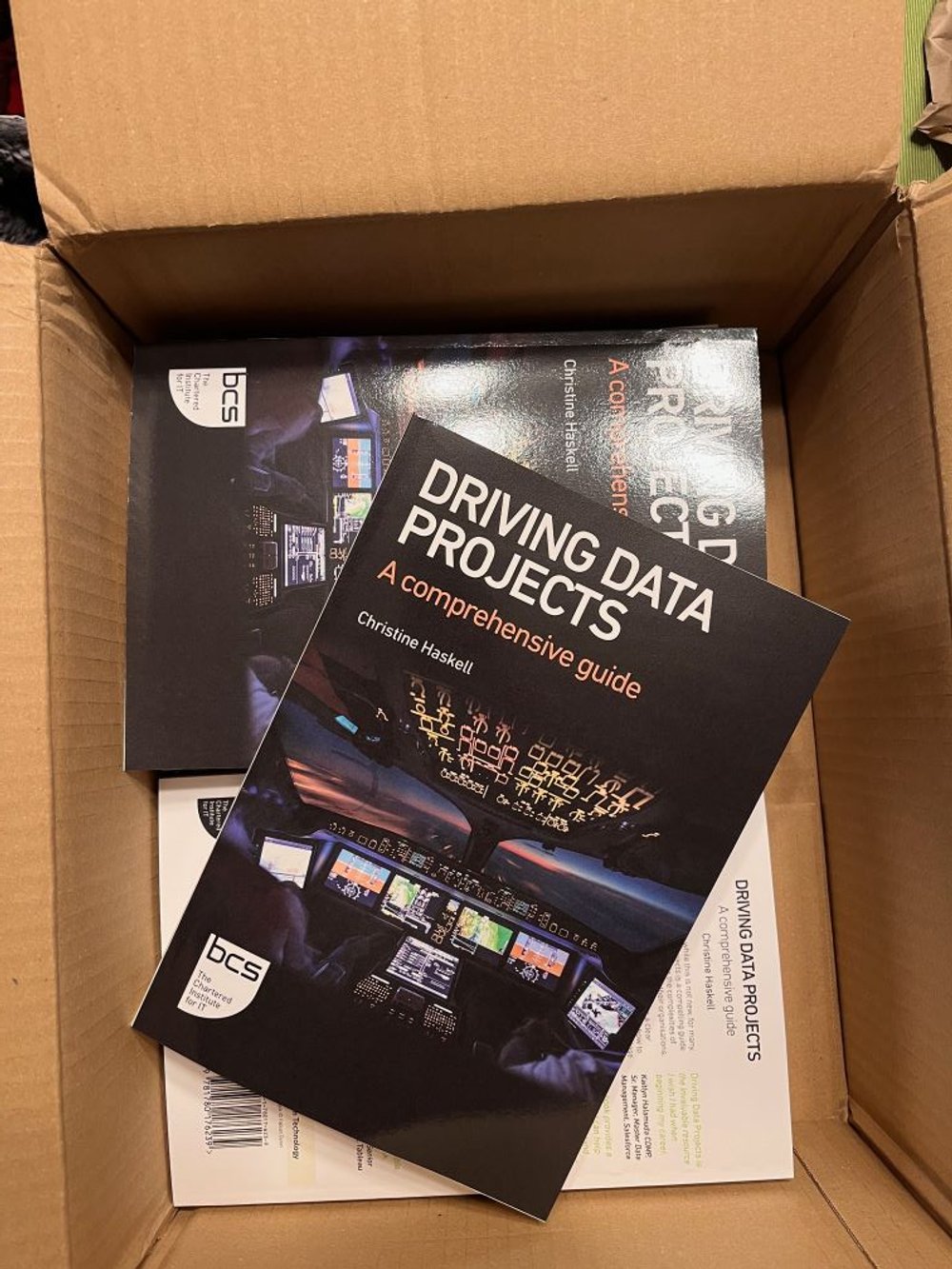
You get an author's box!
I read somewhere that over 80% of adults want to write a book, but only 3% ever get to 'The End' of a draft. That means that 97% of people who want to write a book never finish.
Stats like that make accomplishments like getting my “author’s box” of books all the more rewarding.