
What does Values-Drift really mean?
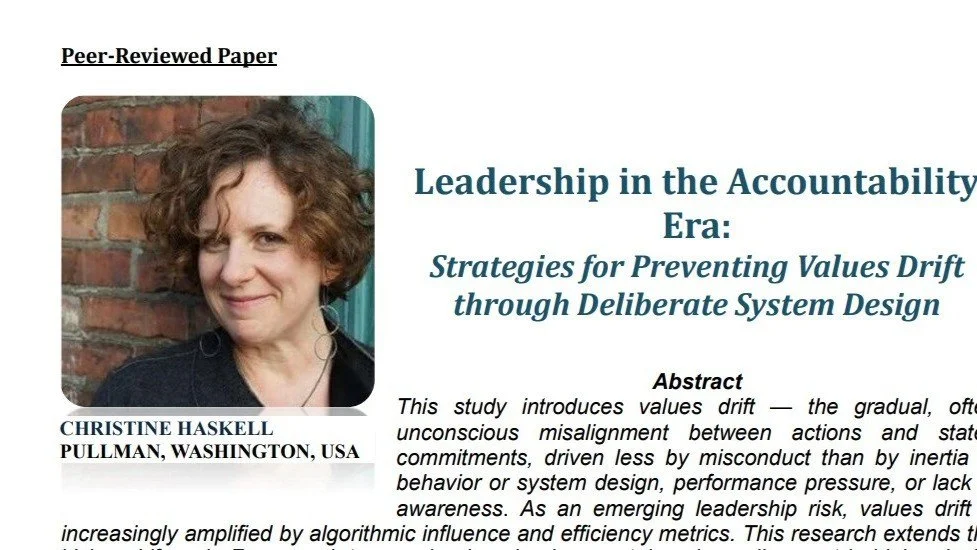
REFERENCE: Haskell, Christine (2025) "Leadership in the Accountability Era: Resisting Values Drift through Deliberate System Design," The Journal of Values-Based Leadership: Vol. 18 : Iss. 2, Article 17. DOI: https://doi.org/10.22543/1948-0733.1575 Designing Against Drift: How Leadership Must Change in the Accountability Era
May 23, 2025
Why Values Drift Matters Now
This story is no longer surprising. It’s a pattern, and a warning. When speed outpaces scrutiny, systems drift. When values are abstract, but systems are concrete, misalignment is built in.
A financial institution launches an AI-powered loan system, cutting processing time by 70%. Market share surges. Inside the data, a familiar pattern emerges: ZIP codes served as a proxy for bias. It wasn’t intentional. It was inherited, embedded, and scaled. But no one questioned it until the damage was already done.
This is an example of values drift: the gradual, often unconscious misalignment between actions and stated commitments. It doesn’t stem from malice. It stems from design gaps: performance pressure, behavioral inertia, and systems optimized for scale, not discernment. Today, with algorithmic tools mediating more of our decisions, values drift isn’t just a personal risk. It’s a leadership one. Left unchecked, it becomes institutional.
From Purpose Statements to Systemic Drift
The last three decades have seen the rise and unraveling of three leadership eras. The Data-Driven Era promised objectivity through systems like Six Sigma and balanced scorecards. But in chasing metrics, many organizations lost sight of meaning. The Purpose Era responded with values-forward initiatives: CSR, stakeholder capitalism, and mission statements, but those aspirations rarely reached system design.
Now we’re in the Accountability Era. A time defined by mounting pressure to prove that our values aren't just spoken—they're governed. The risks are both structural and symbolic.
How Leaders Navigate, or Normalize, Values Drift
In response to this drift, leaders tend to fall into three behavioral postures—each shaped by how they individually recognize and respond to misalignment.
Defaulters stick to what’s familiar. They maintain stability in low-stakes contexts but struggle during rapid change. They don't resist misalignment because they often don't notice it.
Correctors may or may not recognize tension. They hit inflection points where alignment falters, and may or may not intervene. Awareness alone isn’t enough. Without systemic support, even their good intentions stall.
Balancers build pause into the system. They embed reflection into routines, team processes, and decision points—preventing drift before it begins.
These aren’t fixed identities. They're habits, and they tell us something important: values drift doesn’t always appear as a scandal. It often shows up as silence or avoidance. It is the glance away, ghosting, or withholding when a colleague asks for help.
For example, during a major product rollout at a healthcare company, a junior analyst flagged concerns that the predictive model underrepresented rural patients because of spotty data coverage. Leadership didn’t disagree, but no one followed up. The rollout continued. No one debated the omission, let alone corrected it. Instead, the issue was quietly reframed as a “data quality problem” for another team to solve later. Everyone assumed someone else would raise it again. No one did.
This is what drift looks like: not sabotage, but saturation. Not a loud betrayal of values, but a quiet decay—when good people delay hard conversations because speed, alignment, and plausible deniability feel safer in the moment.
How Complexity Is Delegated
Values drift isn’t only a product of bad behavior. It’s a consequence of organizational choices:
HR systems that prioritize time-to-fill metrics over thoughtful evaluation speed up hiring at the cost of cultural fit, long-term equity, and the ability to evaluate ethical complexity in real time. The result: organizational blind spots that replicate bias, degrade trust, and normalize rushed decision-making.
Performance frameworks that reduce ethics to checkboxes—rewarding compliance over critical thinking, and signaling that doing what’s safe matters more than doing what’s right. The result: dissent is silenced, moral nuance is flattened into risk-averse procedures, and over time, these defaults calcify into culture and crowd out adaptive leadership altogether.
Automation processes that replicate legacy logic—embedding bias into decision paths without triggering scrutiny, because the outcomes look 'efficient.' The result: exclusionary patterns scale unchecked, no one formally approves them, and the harm only becomes visible in hindsight, when it’s harder to acknowledge and even harder to unwind.
Often, the real shift happens quietly:
Feedback tools flatten nuance into “meets expectations,” signaling that safety lies in sameness, and inviting neither recognition nor recalibration
Board reports prioritize narrative cohesion over contradiction, masking ethical risk beneath polished visuals and quarterly momentum
Leaders approve AI systems without value audits, letting design defaults dictate whose priorities get scaled, and whose concerns get erased
Every time a leader avoids complexity, they delegate it. Too often, that complexity becomes someone else's jo: —an analyst, a user, a downstream function. That is how misalignment becomes institutionalized.
These examples, too, operate at both the system and behavior level:
In feedback tools, it's defaulting to “meets expectations” when deeper feedback feels too uncomfortable or time-consuming.
In board reporting, it’s removing the one outlier data point that challenges the narrative.
In approving AI systems, it’s skipping the critical design review because the platform is vendor-certified or already in use elsewhere.
Small choices. Quiet consequences. But each one nudges a system further from its stated values.
If you lead, approve, or influence these systems, the real question becomes:
What’s the smallest leadership behavior embedded here?
For example:
In HR, it's approving a job post template that excludes non-traditional career paths.
In performance reviews, it’s defaulting to pre-filled scores without context or coaching.
In automation workflows, it’s skipping the value review because the tool “came pre-trained.”
When we break down the system, we find decisions, not accidents. Naming these decisions reveals the levers leaders can pull to realign values and restore trust.
What Reflective Governance Should Do
This moment demands a new posture: not more rhetoric, but more design. Reflection must be embedded, not assumed. Governance must be relational, not reactive. This means treating values not just as cultural touchstones, but as:
Stabilizers in times of operational continuity
Adaptive cues in moments of pressure or transition
Some might dismiss this as soft. But this isn’t softness. It’s structure. This is what lets leaders pause before they default. Realign before they scale misalignment. And act before the metrics erase the signal.
Precision Isn’t Enough; We Need Design
Reflection cannot remain a personal virtue. It must become an operational norm, built into decision-making cycles with the same rigor we reserve for financial audits or risk protocols. We need to design for reflection the way we design for compliance or risk.
Consider the Corrector who notices a bias in an AI hiring model, but hits institutional resistance. There’s no protocol for re-evaluation, no incentive to pause. Or the Balancer who introduces a “values checkpoint” into a merger process—not to slow things down, but to ensure the decision carries its ethical weight.
This isn’t a question of bravery. It’s a question of architecture. Have we built systems that recognize reflective leadership as competence, or treated it as emotional overhead? It’s about whether the environment is designed to support courage at all, and whether incentives are aligned.
Strategies for Systemic Alignment
Three tiers of strategy emerged from the research. Think of them as upstream, midstream, and downstream interventions: designed to prevent, interrupt, and institutionalize reflection.
First-order (Proactive): Tools like Values Integrity Reviews and Deliberate Pause Practices help Balancers embed reflection upstream, before drift occurs.
Second-order (Corrective): Decision Disruption Protocols allow Correctors to intervene after drift is visible, giving them tools to realign without overreliance on personal courage.
Governance-level (Structural): Data Integrity Reviews, Scenario Planning, and Governance Pause Practices institutionalize reflection, making it resilient across teams and time.
From Reflection to Design
From shifting global tariffs to AI-augmented hiring, we see how reactive decisions ripple across systems and destabilize integrity. Traditional governance was built for stability. But today’s conditions demand adaptive leaders and decision-making processes that can revise the very systems shaping action.
In the Accountability Era, values alignment can no longer rest on individual virtue. It must be operationalized through design. Values drift results from design gaps—where systems outpace discernment, and individual awareness is insufficient without structural reinforcement. Leaders who will earn trust in the years ahead won’t be those who talk most about purpose. They’ll be the ones who build systems that make purpose visible, auditable, and hard to ignore.
Think of reflection not just as a mirror but also as a lever. It shows you who you are and lets you shift a system's weight before it tips.
Reflection isn’t a retreat from action. It’s how responsible systems stay calibrated, and it’s a behavior we urgently need to scale. If we don’t, the cost of drift won’t just be ethical. It will be reputational, operational, and strategic (organizational, national, and global). Drift doesn’t just corrode purpose. It destabilizes institutions and nations.
Reference
Haskell, Christine (2025) "Leadership in the Accountability Era: Resisting Values Drift through Deliberate System Design," The Journal of Values-Based Leadership: Vol. 18 : Iss. 2, Article 17. DOI: https://doi.org/10.22543/1948-0733.1575
Available at: https://scholar.valpo.edu/jvbl/vol18/iss2/17